Every AI headline shows up alone, with no thread back to what came before it.
Turn scattered AI coverage into a connected, cited knowledge graph.
Multi-model summaries route between Groq and OpenAI, extract entities with grammatical verification, and link them into a scored, confidence-ranked knowledge graph.
Live web app · new coverage ingested automatically
- 76%
- cheaper inference via Groq LPU routing vs. OpenAI-only
- 9,556
- entities scored in the first full-corpus run
- 55ms
- spaCy relationship verification response time
Product walkthroughs
See it at work
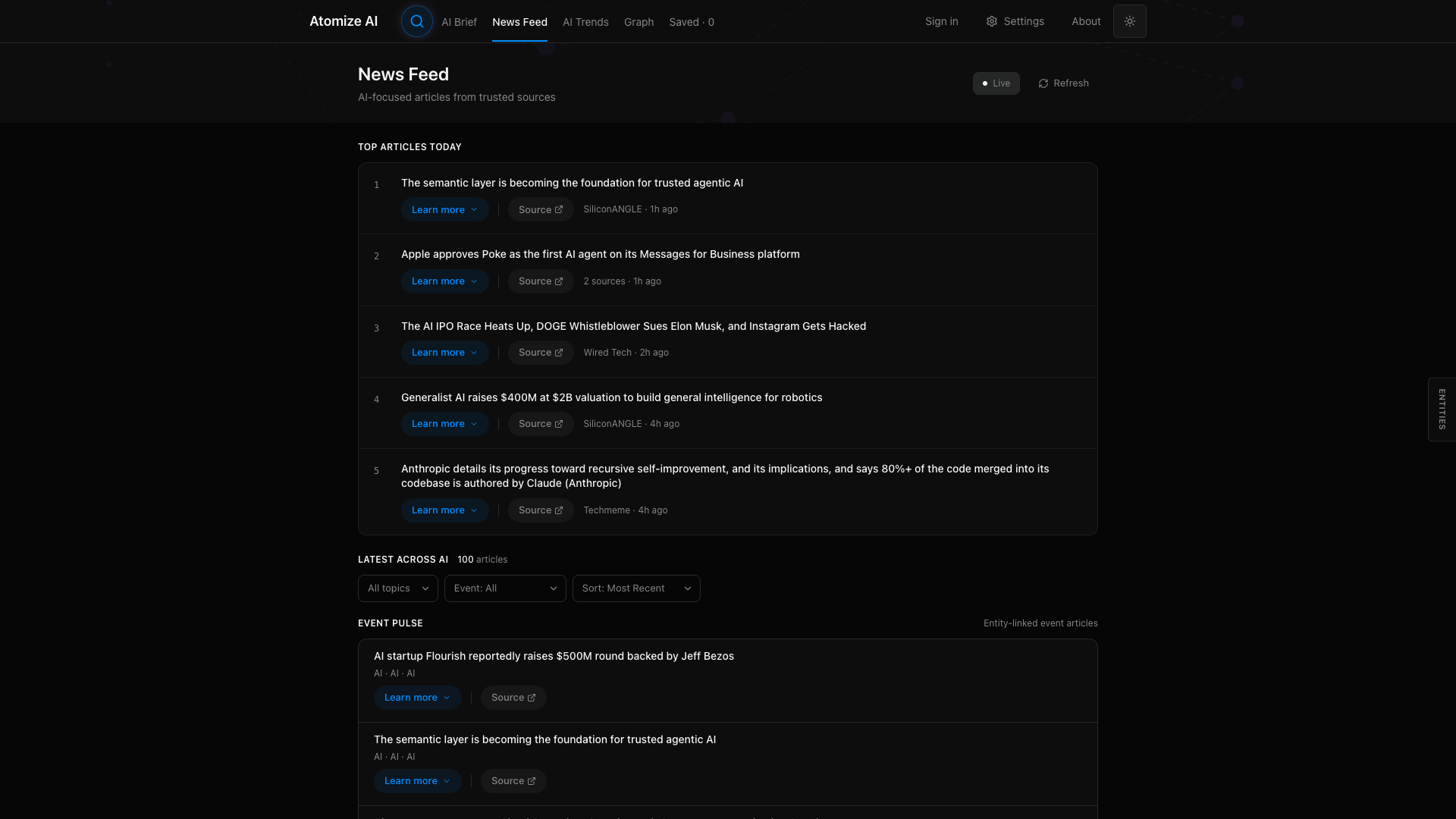
Ranked by how many sources are covering it
AI Brief opens on a podcast-style digest and a ranked Today's Briefing — each item shows how many sources are covering it, so you can see what's converging before you read the piece.
Ask a question, get a cited synthesis
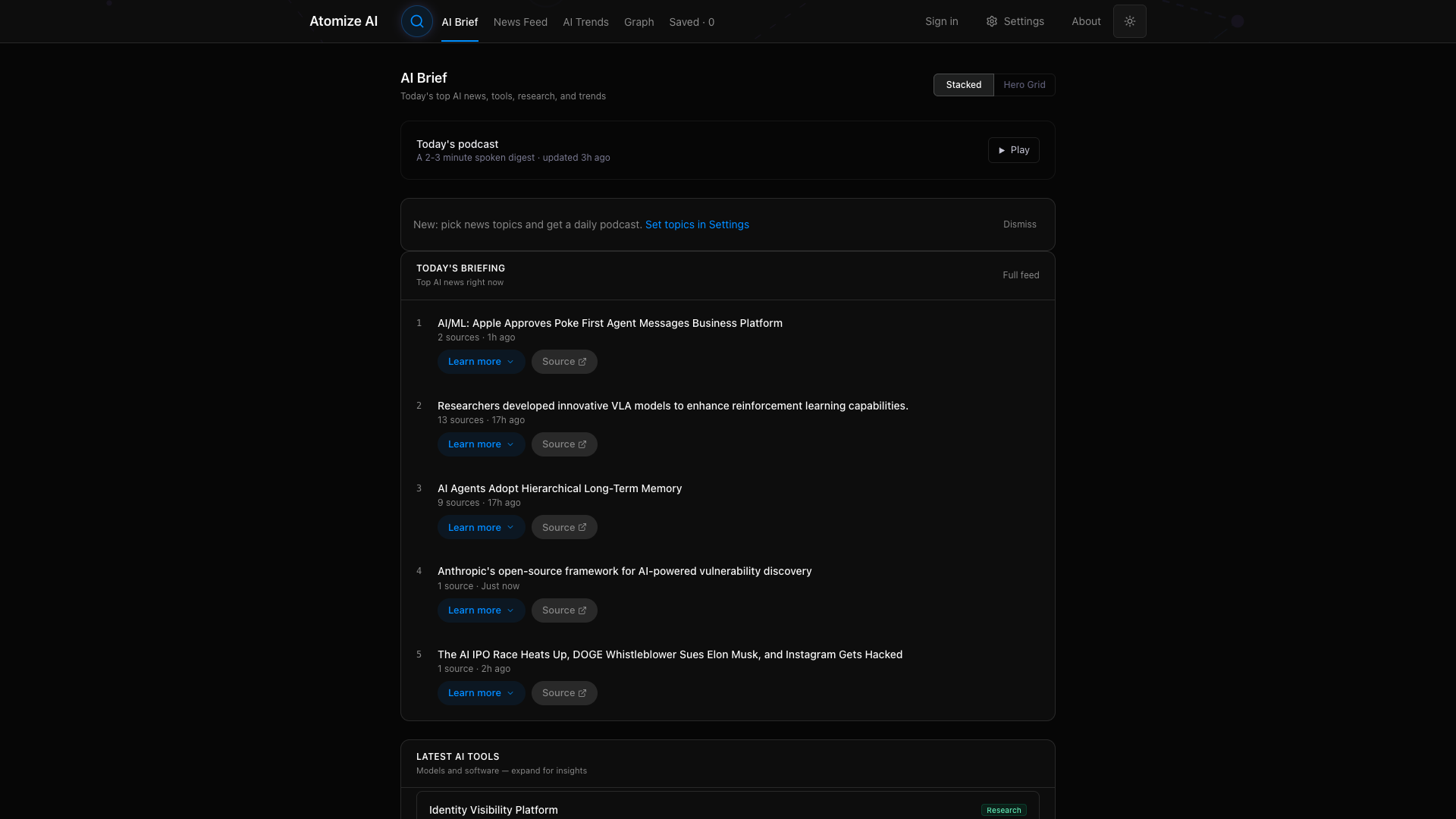
AI Search pulls from every indexed article on a topic — a query like "Enterprise AI Adoption" draws from 50 articles and returns a structured summary with numbered citations back to the source. Simple mode falls back to keyword search when you'd rather browse.
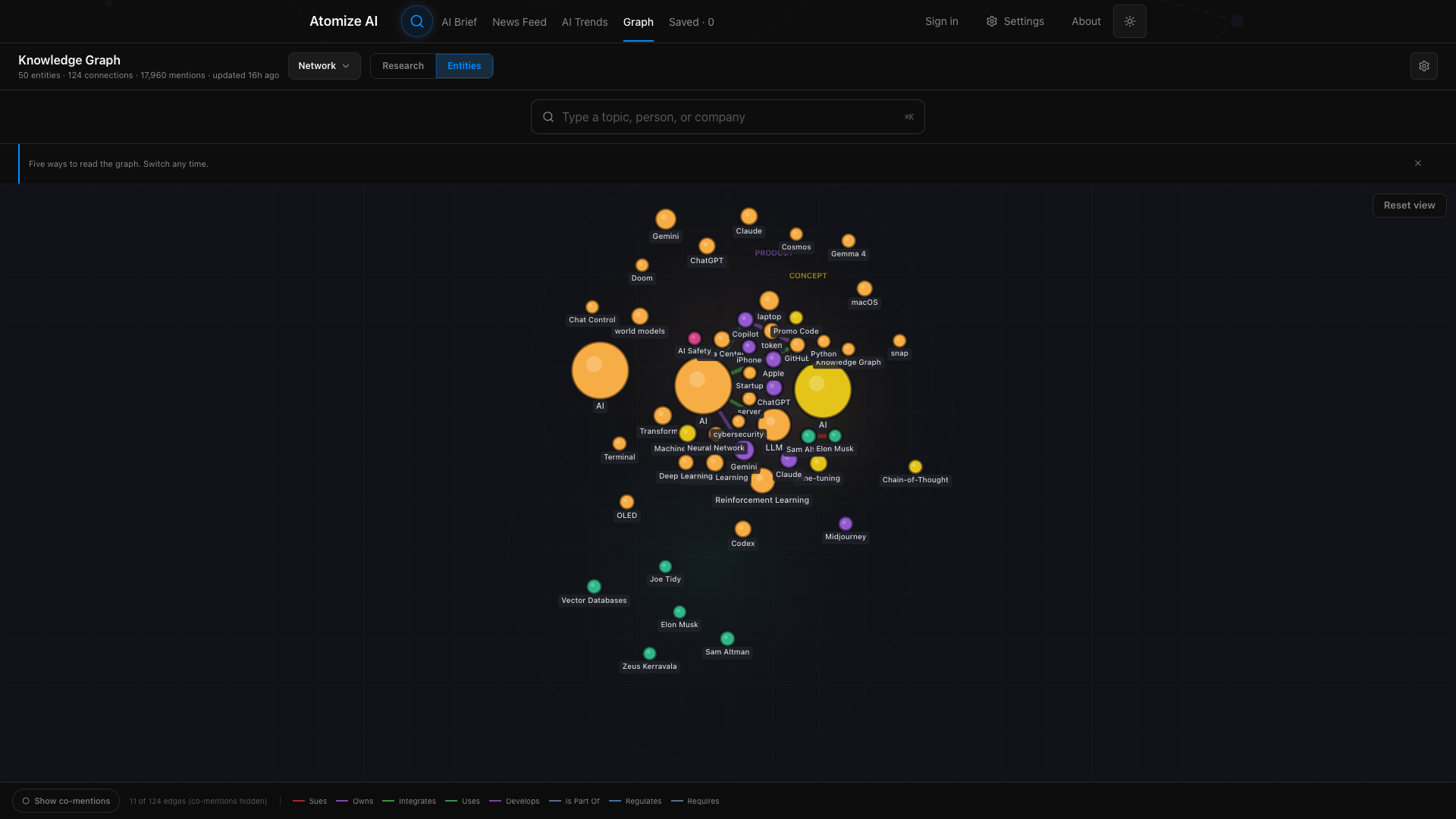
Entities and relationships, not just tags
Every article feeds a graph of typed relationships — owns, integrates, develops, regulates — built from grammatically verified extraction, not LLM guesswork. A six-signal scoring system keeps it from drifting into noise; entities below threshold land in a review queue instead of the canonical graph.
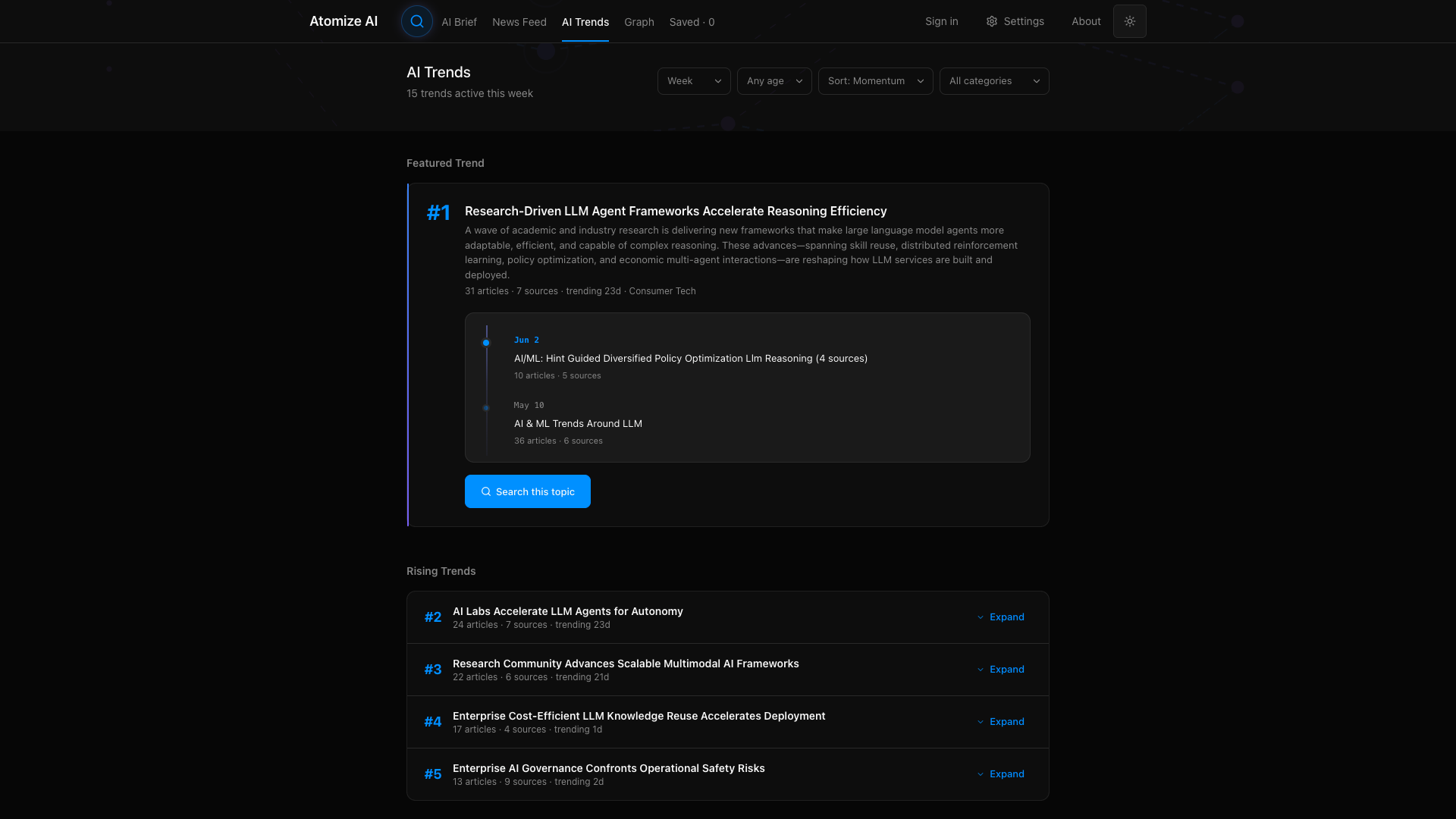
A rolling score of volume and source diversity
Trends are scored by article volume and source diversity over a rolling window, so a featured trend reflects real convergence rather than one loud outlet. Each trend links to a timeline and topic-specific search for the drill-down.
- No relationship enters the graph without grammatical verification — no LLM guessing who acquired whom
- No entity passes into the canonical graph without clearing the six-signal review threshold
- Every synthesized finding cites back to its source article — no unsourced claims
What does it actually pull from?
Academic and corporate AI research — arXiv, Anthropic, and OpenAI — alongside broader AI news coverage, indexed and cross-linked into the knowledge graph.
How does the graph avoid turning into a pile of every name that ever appeared?
A six-signal scoring system — mention frequency, source-tier diversity, recency-weighted velocity, relationship density, citation depth, and an LLM significance score — gates every extracted entity. Anything below threshold lands in a review queue instead of the canonical graph.
Why route between Groq and OpenAI instead of picking one?
A 10-model router sends straightforward summarization and entity extraction to Groq's LPUs — about 76% cheaper — and reserves OpenAI for queries that need deeper reasoning.
Is the code open source?
Not currently — the repo is private. The app itself is live and free to use at atomize-ai.vercel.app.
Atomize AI started as Atomize News, an RSS aggregator, but general tech headlines don’t connect to each other the way research does. I wanted to track AI developments across arXiv, Anthropic, and OpenAI and actually see how they relate — not just read them in sequence.
The hard part turned out to be entity accuracy. LLMs alone will happily reverse a relationship — “Google acquired DeepMind” becomes “DeepMind acquired Google” — so I added a spaCy microservice that checks grammatical structure before anything gets confidence-boosted into the graph. A six-signal scoring pass keeps the graph itself honest: without it, every name and concept that ever appeared in an article would eventually pile up into noise. Multi-model routing across Groq and OpenAI keeps the whole pipeline affordable enough to run continuously.
Live web app · new coverage ingested automatically