Local Smartz
Ports Stratagem's research patterns to run entirely on local hardware — one DeepAgent, 8 custom tools, no cloud LLM — via web UI, CLI, or a native macOS app.
The Problem
Cloud LLM APIs are great until they’re not — privacy-sensitive research, air-gapped environments, or just a desire to control the bill. Most agent frameworks assume an OpenAI-shaped API and fail interestingly when you point them at a local model. Smaller local models also break in different ways than frontier ones: silent tool-call drops, stringified JSON arguments, and runaway loops on ambiguous prompts.
What I Built
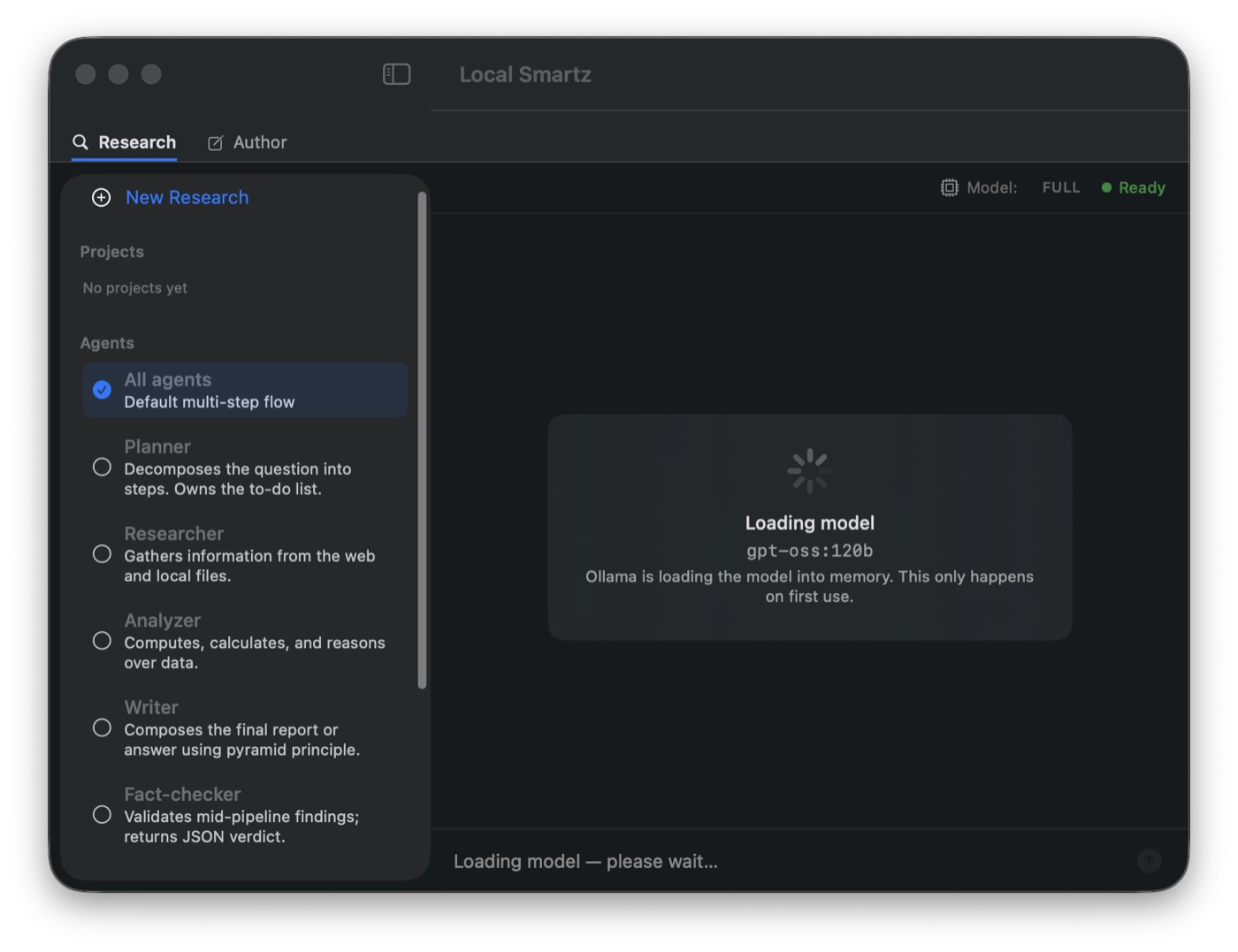
A local-first port of the multi-agent research patterns from Stratagem. Single DeepAgent (LangChain / LangGraph) handles orchestration with built-in write_todos planning, subagent spawning via the task tool, and filesystem-based context offloading. Eight custom tools cover web search, page scraping, PDF/spreadsheet/text parsing, sandboxed Python execution, and report/spreadsheet generation.
Architecture
Every query enters through one router (routing.select_research_runtime) that reads the prompt text and picks one of five execution paths — no LLM makes this decision, it’s regex/keyword matching against the prompt. The default research path is a deterministic LangGraph state machine (pipeline.py), not a free-form agent loop: researcher and analyzer run in parallel, a fact-checker gates the output, and re-dispatch is bounded at 2 iterations. This replaced an earlier prompt-driven DeepAgents orchestrator specifically because small local models (qwen3:8b) forgot to emit parallel task() calls or ignored the fact-checker’s verdict — encoding those steps as graph edges instead of instructions removed that failure mode.
flowchart TD
  A[CLI / REPL / Web UI / macOS app] --> B{Router<br/>routing.select_research_runtime}
  B -->|trivial factual prompt| C["Fast path<br/>fast_model, no tools, no graph"]
  B -->|repo/build-loop/plugin prompt| D["Coding harness / coding loop<br/>repo-grounded, action-oriented"]
  B -->|focus_agent pinned| E["Legacy DeepAgents runtime<br/>single agent + task() delegation"]
  B -->|default research query| F[Entry node]
  F -->|Send, parallel| G[Researcher<br/>web_search, scrape_url, parse_pdf]
  F -->|Send, parallel| H[Analyzer<br/>python_exec]
  G --> I[Fact-checker<br/>JSON verdict: ok / needs_more]
  H --> I
  I -->|needs_more, iters < 2| G
  I -->|ok, or iters exhausted| J[Writer<br/>pyramid-principle synthesis]
  J --> K[SSE stream to caller]
  K --> L[(SQLite checkpointer<br/>threads + messages.jsonl)]
End-to-end data flow
- Entry — a query arrives via CLI (
localsmartz "..."), REPL, the SSE-streaming HTTP server (--serve, stdlibhttp.serveron port 11435), or the SwiftUI macOS app (subprocess-launches the Python backend, streams viaURLSession.bytes). - Routing —
routing.select_research_runtimeclassifies the prompt: trivial factual questions (“what is…”, under 400 chars) go to a fast path that skips the graph entirely; prompts naming a repo/build-loop/plugin path go to a coding harness (read-only repo context) or coding loop (action-oriented); everything else enters the graph pipeline (default since 2026-04-13,LOCALSMARTZ_PIPELINEenv var opts back to the legacy path). - Fan-out — the graph’s
entrynode dispatchesresearcherandanalyzerin parallel via LangGraph’sSend. Researcher callsweb_search(DuckDuckGo viaddgs) thenscrape_url/parse_pdf/read_spreadsheeton the best results. Analyzer runspython_execfor any math the query needs — it has no access to researcher’s output (true parallel branch, no shared disk state). - Verification — both outputs converge on
fact_checker, which re-verifies uncertain claims withweb_search/scrape_urland returns a strict JSON verdict ({"verdict": "ok"|"needs_more", "missing_facts": [...]}).needs_morere-dispatchesresearcherwith the named gaps, capped at 2 extra rounds — after that the graph writes with whatever it has rather than spin indefinitely. - Synthesis —
writercomposes the final answer using pyramid-principle structure (governing thought, then 2–4 MECE key lines, then support), pulling only from the researcher/analyzer outputs already in state — it runs no new searches. - Output & persistence — the answer streams to the caller over SSE, token-by-token.
threads.pypersists the exchange to.localsmartz/threads/{thread_id}/messages.jsonlplus an auto-generatedcontext.mdsummary (loaded back into the system prompt on thread resume);artifacts.pytracks every generated file (report, spreadsheet) in an index. A SQLite-backedSqliteSaver(langgraph-checkpoint-sqlite) checkpoints agent state so a thread survives a backend restart.
Models — which, where, why
All inference is local via Ollama by default; no cloud API key is required to run the app.
| Profile | Role(s) | Model | Why here |
|---|---|---|---|
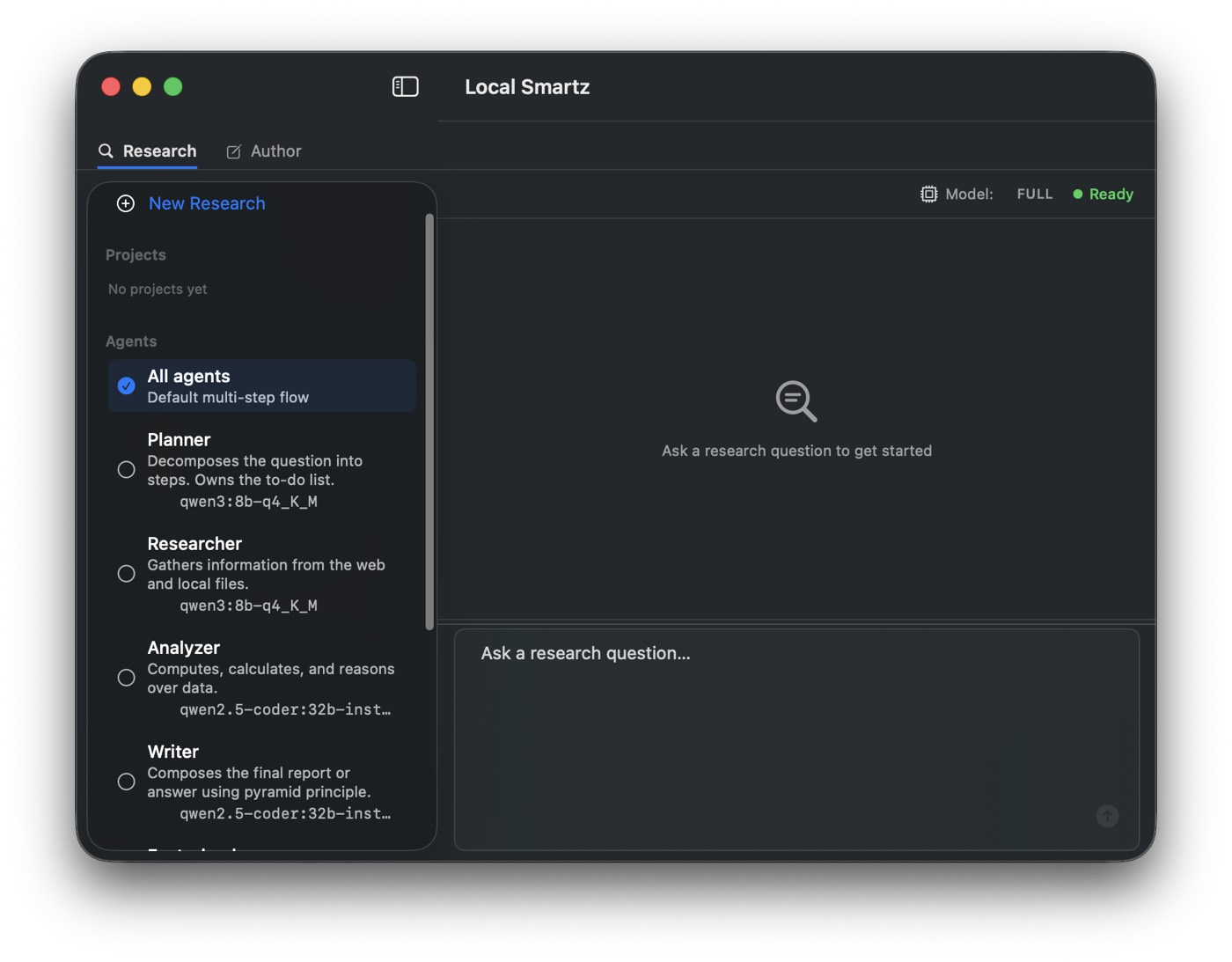
| full (≥64 GB RAM) | planner, researcher, writer, fact_checker, orchestrator | gpt-oss:20b | Tool/agent-oriented model, lighter than gpt-oss:120b — used everywhere except the compute-heavy analyzer role |
| full | analyzer / execution | qwen2.5-coder:32b | Code-and-math-specialized model reserved for the one role that runs arbitrary Python |
| full & lite | fast path (trivial factual prompts) | qwen3:8b-q4_K_M | Keeps first-token latency low for one-line answers by never loading the 20B/32B models |
| lite (<64 GB RAM) | every role (planner/researcher/analyzer/writer, no fact-checker, no subagent delegation) | qwen3:8b-q4_K_M | Single 8B model fits a 20 GB M4 with room to spare; the profile also swaps in a stricter one-tool-per-turn system prompt, a 5-tool whitelist, a 10-turn cap, and a loop detector — mitigations for the specific failure modes small local models exhibit (tool-name hallucination, stringified JSON args, runaway loops) rather than trusting a bigger prompt to prevent them |
Hardware profile is auto-detected from system RAM (sysctl hw.memsize on macOS) at ≥64 GB → full, else lite; overridable with --profile lite.
Cloud fallback (opt-in, off by default). A “Local-Only” setting gates cloud providers — when it’s on (default, and fail-closed if the config can’t be read), any non-Ollama provider is blocked outright. When a user explicitly enables a cloud provider, routing.py’s tier table maps each role to cheap/mid/strong and picks a concrete model per provider: Anthropic (claude-haiku-4 / claude-sonnet-4-6 / claude-opus-4-7), OpenAI (gpt-4o-mini / gpt-4o), Groq (llama-3.1-8b-instant / llama-3.3-70b-versatile / openai/gpt-oss-120b). This is a manual escape hatch for users who want cloud-quality synthesis, not a default routing signal — the project’s premise is that inference never has to leave the machine.
Tools & infra
| Component | Choice | Why |
|---|---|---|
| Orchestration | LangGraph (StateGraph, Send) + DeepAgents (legacy path) | Deterministic graph edges replace LLM-decided control flow for the failure modes small local models hit (missed parallel dispatch, ignored verdicts) |
| LLM runtime | Ollama via langchain-ollama (ChatOllama), not the OpenAI-compat shim | The OpenAI-compatibility layer silently drops tool calls in streaming mode; langchain-ollama keeps the tool-call channel intact |
| Checkpointing | SQLite (langgraph-checkpoint-sqlite, one checkpoints.db per project) | Threads resume across process restarts without an external database — matches the local-first, single-user scope |
| Thread/artifact store | Flat files: messages.jsonl + context.md per thread, artifacts/index.json | Ported from a prior project (Stratagem); no DB needed for a per-project, single-user append log |
| Web search | ddgs (DuckDuckGo) | No API key required — keeps the zero-cloud-dependency story intact for the research tool itself |
| Scraping / documents | beautifulsoup4 + lxml, pypdf/pdfplumber, openpyxl, python-docx | Standard, dependency-light parsers for the source formats research tasks actually hit |
| Sandboxed compute | python_exec — subprocess python3 call, 30s timeout, script saved to .localsmartz/scripts/ for audit | Every numeric answer must flow through here, never LLM-generated arithmetic — local models hallucinate math reliably |
| Observability | OpenTelemetry → OTLP/HTTP → local Arize Phoenix collector (localhost:6006) | Opt-in (--observe, dev dependency group) so the base install stays light; traces every tool call and model turn without a hosted telemetry bill |
| Secrets | keyring (macOS Keychain / Linux secret-tool / file fallback) | Only path that touches secret storage — cloud provider API keys, when a user opts in |
| Web/desktop surface | stdlib http.server (no framework) + SSE, SwiftUI macOS app (NavigationSplitView, MenuBarExtra, URLSession.bytes for streaming) | Zero extra server dependency for the bundled DMG; native macOS chrome without a second backend |
Tech stack
Python 3.12, Ollama (gpt-oss:20b planning/writer/researcher/fact-checker, qwen2.5-coder:32b analyzer, qwen3:8b-q4_K_M lite-profile and fast-path), DeepAgents + LangChain + LangGraph (StateGraph/Send deterministic pipeline), langgraph-checkpoint-sqlite (thread checkpointing), ddgs (web search), BeautifulSoup/lxml + pypdf/pdfplumber + openpyxl + python-docx (scraping and document parsing), OpenTelemetry + Arize Phoenix (opt-in local tracing), keyring (secret storage), stdlib http.server + SSE (web UI/API), SwiftUI (macOS app). Cloud fallback, off by default: Anthropic / OpenAI / Groq via langchain-anthropic and langchain-openai.
Surfaces
- CLI —
localsmartz "question", interactive REPL,--thread <name>for resumable research,--list-threads - HTTP server —
localsmartz --serveruns an SSE-streaming server on127.0.0.1:11435(stdlibhttp.server, no extra deps) - macOS app — SwiftUI wrapper around the Python backend. NavigationSplitView for thread history, streaming output, MenuBarExtra. Subprocess-launched backend, SSE streamed via
URLSession.bytes. Builds via XcodeGen + Xcode 14+, ships as a DMG.
Key Design Decisions
Calculation policy is non-negotiable — every numeric answer flows through python_exec, never LLM-generated arithmetic. Local models hallucinate numbers reliably.
Sync tools, not async — local models behave better with synchronous tool execution. The async-first patterns common in cloud frameworks introduce timing variability the local stack handles poorly.
ChatOllama, not OpenAI compatibility shim — the OpenAI-compat layer silently drops tool calls in streaming mode. langchain-ollama keeps the tool-call channel intact.
Thread context + artifact manifest — ported wholesale from Stratagem. messages.jsonl + context.md per thread, plus an artifact manifest tracking every generated output. Research is resumable across sessions.
Resilient parameter parsing — create_report and create_spreadsheet accept both list-of-dict and stringified JSON arguments. Local models stringify roughly 20% of structured tool calls; rather than fight that, parse both shapes.
Results
⚠️ no benchmark yet — no throughput, accuracy, or task-completion numbers have been published for either hardware profile. What’s on record from the build: two auto-detected profiles (full on a 128 GB Mac, lite on a 20 GB M4), an observed ~20% stringified-JSON rate on structured tool calls from local models (the reason create_report/create_spreadsheet parse both shapes), and a fixed 5-tool whitelist plus turn-cap for the lite profile’s loop detector. No end-to-end research-run timing, cost, or output-quality measurements exist yet.